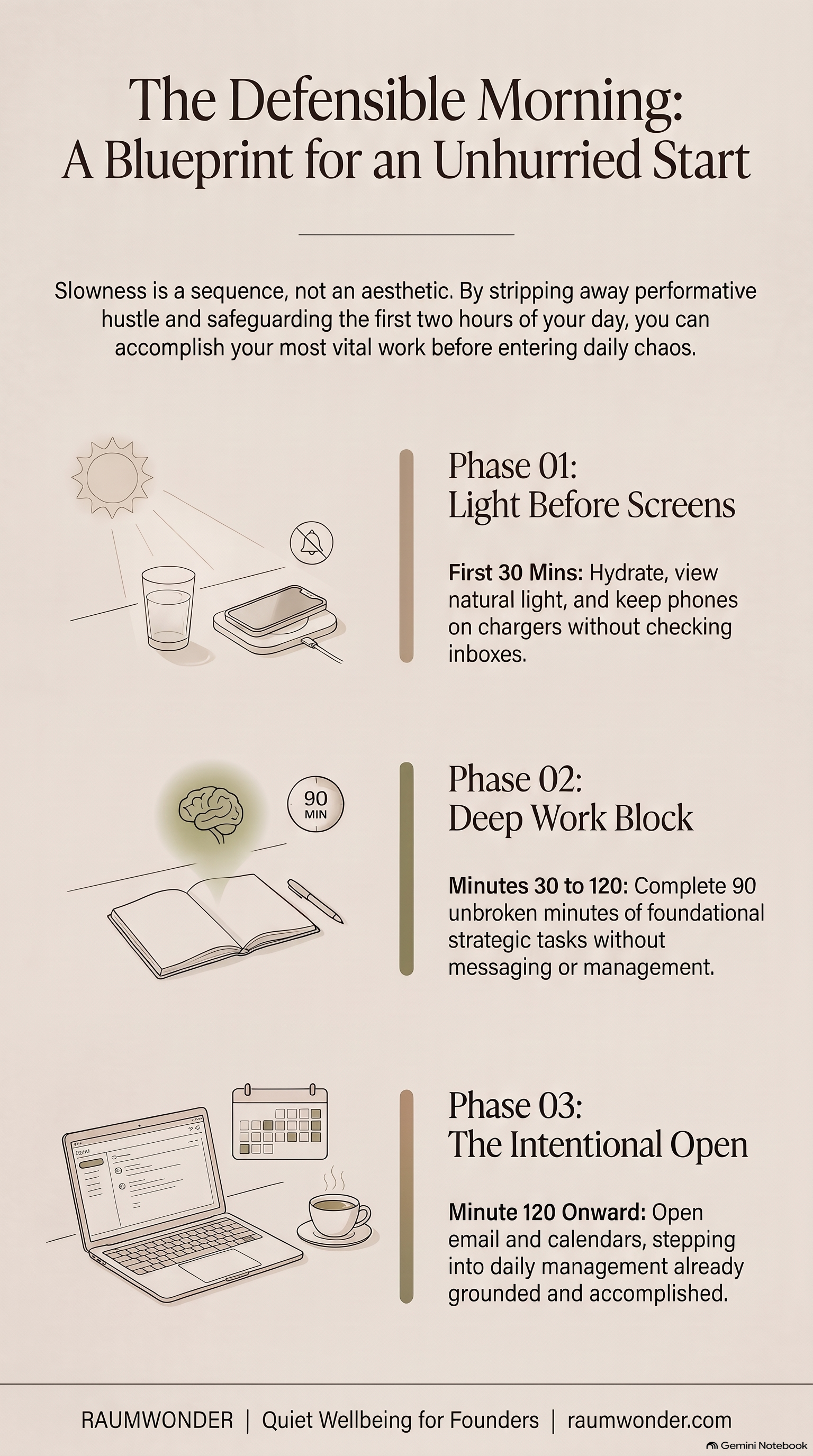
The founder's morning has become its own genre: 4 a.m. alarms, cold plunges, a row of supplements photographed in raking light. Most of it is theatre. Someone who runs a company does not need another ritual to perform; they need two protected hours that survive a funding round, a hiring crisis and a child with a fever. What would a morning look like if it were designed like a building, load-bearing elements first and ornament optional?

Light Before Screens
The most defensible element of any morning is also the cheapest. Light is the primary cue that aligns the body's circadian clock with the solar day, and the evidence for morning exposure is consistent, if more modest than wellness marketing suggests. A 2025 study in BMC Public Health linked every additional 30 minutes of sun before 10 a.m. with a sleep midpoint roughly 23 minutes earlier. It found no clear effect on total sleep time.
Better alignment, then, rather than a miracle.
Take Your First Steps
Take the first call or coffee outdoors, or beside your largest window.
In a northern November, overcast daylight outdoors still tends to outperform indoor lighting.
Treat it as timing, not therapy.
The Inbox Opens Once
Email is where a founder's morning quietly dissolves. In a two-week field experiment at the University of British Columbia, Kostadin Kushlev and Elizabeth Dunn asked 124 adults to check email only three times a day for one week. Participants reported significantly lower daily stress than in their unlimited week, and felt no less productive. The caveat matters: most found the limit difficult to keep.
So why rely on willpower? Remove the notifications and decide in advance when the inbox opens.
How to Do This
Keep mail and Slack closed until a fixed hour, 9:30 for example.
Leave one emergency channel open, such as a phone call from your co-founder.
Tell your team the window exists. A published boundary holds better than a private one.
The Maker's Block, Defended
In his 2009 essay "Maker's Schedule, Manager's Schedule," Paul Graham argued that people who make things need long, unbroken stretches of time, while managers live in hourly slots, and that the trouble begins when the two collide. Founders are both. The morning is usually the only part of the day the maker can win. Ninety minutes on the pricing memo, the hiring plan or the board narrative, before the calendar fills, is not indulgence. It is the work nobody else can do.
Create Your Individual Schedule
Book the block as a recurring meeting with yourself.
Choose the single problem the night before.
Hold office hours later in the day, as Graham does.
The Founder Rule
For founders, slowness is not an aesthetic. It is a sequence: light, then thought, then other people. None of it requires linen, a cold plunge or an earlier alarm.
Which hour of your morning currently belongs to someone else, and what would it cost to take it back?
Download Your The Defensible Morning Blueprint here.